How to Choose an Electric Sauna Heater in the UAE: Voltage, Power & Safety Guide
The heater is the heart of the sauna. Get it right and your sauna will reach temperature in fifteen minutes, hold steady heat for years, and run safely through thousands of sessions. Get it wrong and you’ll fight underperformance, tripped breakers, premature element failure, and — in the worst cases — genuine safety risks.
This guide walks you through every decision that actually matters when choosing an electric sauna heater for the UAE: the voltage and power realities specific to Dubai homes, how to size your heater correctly, which safety standards to demand, what separates premium brands from imported budget units, and the installation rules that the best contractors follow as standard. Whether you’re planning a home sauna Dubai project, a hotel wellness suite Dubai spec, or a multi-cabin commercial sauna installer GCC build, the principles here apply.
Why the Heater Choice Matters More Than Anything Else
A sauna is a simple room with one job: get hot, hold heat, deliver löyly when water hits the stones. Almost everything you experience inside that room — how fast it heats up, how stable the temperature is, how the steam behaves when you ladle water onto the stones, how the timber smells, how long the unit lasts — comes back to the heater.
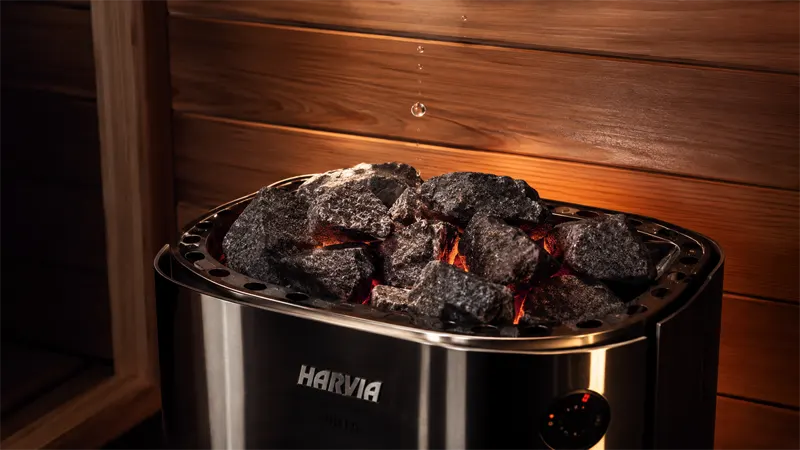
A premium Harvia sauna UAE unit will outlast three or four budget imports. The element design, the casing steel grade, the safety controls, and the stone capacity all matter more than the price tag suggests. This isn’t the place to economize.
Step 1: Understand the UAE Electrical Context
Before you look at a single heater spec sheet, you need to know what your home or building can actually supply.
The UAE standard:
- Voltage: 220–240V at 50Hz
- Single-phase supply is universal in apartments and most townhouses
- Three-phase (400V) is standard in villas, larger townhouses, and commercial properties
- DEWA, ADDC, SEWA, and FEWA all coordinate connections in their respective emirates
What this means for heater selection:
- Heaters up to 4.5 kW typically run on single-phase 240V — apartment-friendly
- Heaters from 6 kW upwards almost always require 3-phase 400V — villa or commercial only
- Heaters above 9 kW require dedicated 3-phase circuits with appropriate breaker sizing
If you’re in an apartment without 3-phase access, your realistic options are smaller cabins (under 6 m³ volume) with heaters up to 4.5 kW, or infrared sauna Dubai alternatives which run on standard single-phase circuits.
A DEWA approved sauna contractor will check your existing supply, calculate the load impact, and coordinate any necessary upgrade before commissioning. This is non-negotiable — running a 9 kW heater off an inadequate circuit is exactly how electrical fires start.
Step 2: Size the Heater Correctly
This is where most DIY buyers and inexperienced installers get it wrong. Undersized heaters never reach temperature properly. Oversized heaters cycle aggressively, stress the elements, and waste energy.
The baseline rule: approximately 1 kW per cubic meter of sauna volume — but with adjustments for room characteristics.
Calculate your volume:
Length (m) × Width (m) × Height (m) = Volume in m³Then add capacity for these factors:
- Glass walls or door panels: add 1.5× the glass area’s equivalent volume
- Stone or tile feature walls: add 1.2× that surface area’s equivalent volume
- Uninsulated walls (rare in good builds): add 2× that surface area’s equivalent volume
- Ceilings above 2.4m: recalculate with the actual height
Quick reference for typical Dubai residential saunas:
| Sauna Volume | Heater Power | Phase Required |
|---|---|---|
| Up to 4 m³ (compact 2-person) | 3.5–4.5 kW | Single-phase |
| 4–6 m³ (3-person) | 4.5–6 kW | Single or 3-phase |
| 6–9 m³ (4-person family) | 6–8 kW | 3-phase |
| 9–13 m³ (5–6 person) | 9 kW | 3-phase |
| 13–20 m³ (commercial / spa) | 10.5–15 kW | 3-phase |
| Over 20 m³ (large commercial) | 18 kW+ | 3-phase, often dual heaters |
If you have a feature glass front, push one bracket higher than the table suggests. A best sauna installer Dubai team will do this calculation as part of the design process — but it’s worth understanding so you can validate the spec yourself.
Step 3: Choose the Right Heater Type
There are four main categories of electric sauna heater. The right one depends on your room size, layout, and design intent.
Wall-Mounted Heaters
The most common format for residential saunas. Mounted on a load-bearing wall, typically with the bench above and clearance below. Power range usually 4.5–9 kW. Brands like Harvia and Tylo offer beautiful wall-mounted units in stainless steel, black powder coat, or premium finishes.
Best for: Most residential villa sauna installer projects.
Floor-Standing / Pillar Heaters
Heaters that stand on the floor as a sculptural element, often in larger saunas. They hold significantly more stones (sometimes 90+ kg) and deliver heavier, more authentic löyly when water is added.
Best for: Larger family saunas, premium sauna room Dubai statement builds, and serious enthusiasts who want maximum steam intensity.
Combi Heaters (Sauna + Steam Function)
Heaters with an integrated water reservoir that can produce both traditional dry sauna heat and a humidified soft-steam experience. Harvia and Tylo both make excellent combi units.
Best for: Owners who want flexibility in a single cabin without committing to a separate steam room build. A good compromise where space prevents a full wet and dry sauna installation.
Underfloor / Bench-Concealed Heaters
Newer designs that hide the heater entirely beneath bench woodwork, with the heat radiating up through gratings. Aesthetically minimalist, technically more demanding to install.
Best for: Architectural custom sauna design Dubai projects where the visible heater conflicts with the design intent.
Step 4: Verify Safety Standards and Certifications
This is where the difference between a premium heater and a cheap import becomes critical. A sauna heater runs at element temperatures above 350°C, drives a high electrical load, and operates in a closed space with people in it. Safety standards exist for good reason.
What to demand on the spec sheet:
- CE marking (European Conformity) — required for legal sale across most of the world
- EN 60335-2-53 — specific safety standard for sauna heaters
- IP rating — at minimum IP24 for residential, IP54 for commercial
- Built-in over-temperature cutout — automatic shutoff if the unit overheats
- Time-limit safety — automatic shutoff after a maximum runtime (typically 4–6 hours residential, 12 hours commercial)
- Door safety switch (recommended for commercial) — heater cuts power if door is propped open
UAE-specific:
- ESMA conformity (Emirates Authority for Standardization and Metrology) is the equivalent UAE marking — increasingly required for imported electrical equipment
- DEWA approval for installation — separate from product certification, this covers the electrical commissioning
- Dubai Civil Defence sauna compliance — required for commercial installations and increasingly relevant for high-end residential
A heater without CE marking is not legal to install in a regulated environment. A trusted steam room contractor or DEWA approved sauna contractor simply won’t touch unmarked units.
Step 5: Choose Your Brand (and Why It Matters)
UAE conditions — high ambient summer temperatures, varying humidity, hard tap water — are unforgiving on cheap heaters. The three brands that consistently perform in the UAE market:
Harvia (Finland)
The benchmark for residential and commercial saunas globally. Heaters run from compact 2.3 kW units up to 18 kW commercial models. Built with high-grade stainless steel, excellent stone capacity, and a wide range of designs from minimalist to statement. Working with a Harvia authorised dealer UAE gives you full warranty cover and access to the genuine spare parts ecosystem.
Where it leads: Reliability, design range, warranty support.
Tylo (Sweden)
Premium Swedish engineering with a particularly strong reputation for residential and high-end spa applications. Tylo’s element design is genuinely superior for fast warm-up times. A Tylo supplier Dubai can spec everything from compact units through to large commercial heaters.
Where it leads: Build quality, fast heat-up, premium aesthetic.
EOS (Germany)
Common in luxury hospitality projects across the GCC. EOS heaters are known for their robust commercial-grade construction and excellent control system integration. Often specified in hotel sauna supplier UAE projects and high-end luxury spa supplier UAE builds.
Where it leads: Commercial reliability, control integration, hospitality-grade specification.
Other brands — Sawo, Sentiotec, Helo — also produce respectable units and may be appropriate for specific applications. The brands to be cautious of are unbranded or thinly-branded units that appear on marketplace platforms at suspiciously low prices. The sauna heater price UAE range varies enormously, and the cheapest options almost always cost more in the long run through failures, inefficiency, and warranty headaches.
Step 6: Specify the Controller
The controller is how you actually use the heater. Two main categories:
Built-In Mechanical Controllers
A simple timer and thermostat dial on the heater itself. Cheapest option, perfectly functional for basic residential use. You set the temperature, set a delay timer if you want, and walk away.
Pros: Cheap, robust, no electronics to fail. Cons: Less precise, no remote operation, less attractive aesthetically.
External Digital Controllers
A wall-mounted digital panel, typically outside the sauna, with full temperature programming, scheduling, and sometimes smart-home integration.
Pros: Precise control, pre-heating from outside the room, scheduling, app integration with premium units, required for most commercial installations. Cons: Higher cost, more components.
Smart controllers — WiFi-enabled, app-controlled — have become standard in premium luxury wellness installation projects. Being able to preheat your sauna while you’re still in your car coming home from a workout is one of the small luxuries that genuinely changes how often you actually use the room.
For commercial work — gym steam room installer, hotel steam room installation, commercial sauna installer GCC — external digital controllers with time and temperature limits are typically mandatory under DCD compliant wellness installation standards.
Step 7: Don’t Forget the Stones
The stones aren’t a detail. They are the thermal mass that gives a sauna its character.
What to look for:
- Material: olivine diabase, peridotite, or vulcanite are the standards. Don’t use random rocks.
- Size: 5–10 cm pieces for most heaters; larger stones for floor-standing units
- Quantity: every heater has a recommended stone load — fill it correctly, neither overpacked nor sparse
- Quality: premium brand stones come pre-washed and dust-free
- Replacement: every 1–2 years for regular use, sooner if you ladle water frequently
A reputable sauna room supplier UAE will include the correct stone quantity with a new heater and brief you on replacement scheduling.
Common Mistakes UAE Buyers Make
After thousands of installations across the region, the same mistakes recur:
- Buying the cheapest unit available online. The savings are illusory — failures within 18 months are typical.
- Wrong sizing. Underpowered heaters that never quite get hot are the most common complaint, usually traceable to a buyer who picked a smaller unit to save on running costs.
- Ignoring 3-phase requirements. Spec’ing a 9 kW heater for a property without 3-phase supply leads to expensive electrical upgrades mid-project.
- Skipping the external controller for commercial. Then failing Dubai Civil Defence sauna compliance inspection.
- Cheap stones. Dust in the cabin, faster element failure, poor löyly quality.
- No professional commissioning. A heater needs to be tested at full load, balanced across phases, and verified against the controller before signoff. Skipping this is how problems hide until they become serious.
What Professional Installation Should Include
When you engage a professional steam room contractor UAE or best sauna installer Dubai team for the heater portion of a project, the scope should include:
- Load calculation and verification against existing supply
- DEWA coordination and electrical signoff
- Heater mounting per manufacturer clearance specifications
- Element commissioning and full-load test
- Controller programming and calibration
- Stone loading and water-test ladle
- Owner handover including maintenance schedule
For commercial installations, add fire safety integration, time/temperature limit programming, and DCD documentation.
Frequently Asked Questions
How many kW do I need for my sauna?
As a baseline, allow approximately 1 kW per cubic meter of sauna volume. Add capacity for glass walls, stone features, or uninsulated surfaces. A typical 4-person residential sauna (around 7 m³) needs a 6–8 kW heater. For commercial use, sizing requirements are usually 25–30% higher.
Can I run a sauna heater on single-phase power in my Dubai apartment?
Yes, for heaters up to approximately 4.5 kW. Above that, 3-phase 400V is typically required, which most apartments don’t have. For apartment installations, compact saunas with single-phase heaters or infrared sauna installation Dubai alternatives are usually the realistic path.
What’s the difference between Harvia and Tylo heaters?
Both are premium European brands with excellent reputations. Harvia offers the wider product range and design options, including statement floor-standing units. Tylo is particularly strong on residential build quality and fast warm-up times. Either choice through an authorised dealer is a safe long-term investment.
How long do sauna heaters last in the UAE?
A premium brand heater installed correctly typically lasts 10–15 years with basic maintenance. Element life depends heavily on usage frequency, water quality (relevant for combi units), and stone replacement discipline. Budget heaters often fail within 2–4 years.
Do I need ESMA or DEWA approval to install a sauna heater?
Yes — both. The heater itself should carry ESMA or equivalent international conformity marking. The installation requires DEWA electrical signoff, particularly for 3-phase units. A DEWA approved sauna contractor handles this end to end.
How often should I replace the sauna stones?
For regular residential use, every 1–2 years. Stones gradually crack and disintegrate from thermal cycling, which reduces heat retention and can damage elements. Commercial saunas may need replacement more frequently. Use only approved sauna stones — never substitute random rocks.
Are infrared saunas a good alternative to traditional electric heaters?
Yes, for many UAE users. Infrared cabins run on standard single-phase circuits, fit into smaller spaces, heat up faster, and operate at gentler temperatures. They don’t replace the immersive experience of a traditional Finnish sauna but are an excellent option for daily use or for apartments where 3-phase power isn’t available.
What’s the typical sauna heater price in the UAE?
Premium residential heaters from Harvia or Tylo typically range from AED 4,500 for compact units to AED 15,000+ for larger or design-statement floor-standing models. Commercial heaters range from AED 12,000 to AED 30,000+. Avoid heaters priced significantly below these ranges — they’re almost certainly not certified or built to last.
Can a combi heater really replace a separate steam room?
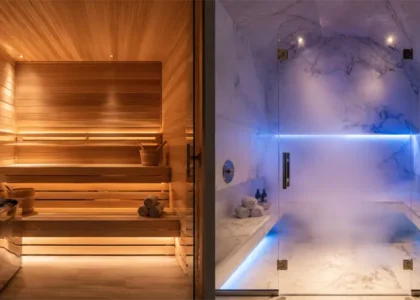
Partially. Combi heaters produce light, soft humidity rather than the full 100% humidity of a dedicated steam room. They’re an excellent middle-ground for owners who want both experiences but lack space for two rooms. For a true steam experience, a dedicated steam generator installation with a proper marble steam room or tiled cabin is still the gold standard.
Making the Final Call
The sauna heater is one of the few home purchases where the cheapest option is almost guaranteed to be the most expensive choice over time. Get the brand right, get the sizing right, get the electrical work coordinated properly, and a quality heater will give you fifteen years of reliable performance with minimal fuss.
When you’re ready to specify the right heater for your project — whether that’s a compact home sauna Dubai install, a full villa sauna installer scope, a commercial steam room Dubai build, or a multi-cabin luxury spa installation Dubai — speak to a specialist team that can walk you through brand selection, load calculations, controller options, and full DEWA approved commissioning.
A well-chosen heater fades into the background. You stop thinking about it. You just step into a sauna that works, every time, year after year. That’s the goal.